←All Technical Articles
Web EngineeringJun 7, 2026·15 min read·Peer-Reviewed Blueprint

Next.js vs WordPress vs Webflow: Which Platform Should Power Your Business in 2026?

A deep architectural and financial showdown between Next.js 16, WordPress, and Webflow: Core Web Vitals, 3-year TCO, security vulnerabilities, and SEO supremacy.

Key Focus:Next.jsWordPressWebflowWeb Performance
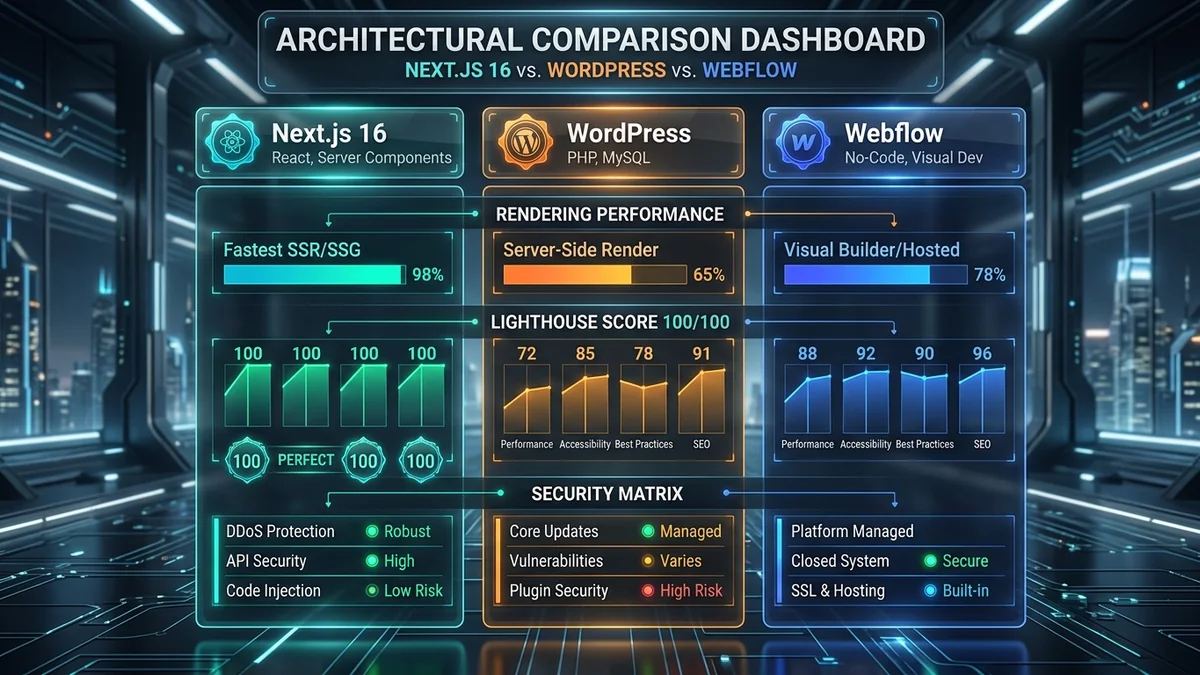
Technical architecture comparison between Next.js React, WordPress PHP, and Webflow SaaS — Binary Froster
Figure 1: Performance, security, and extensibility radar: analyzing how headless React platforms outperform legacy CMS architectures.

Choosing your primary web platform is not merely a design aesthetic choice; it is an architectural foundation that dictates your site speed, Google search ranking, cybersecurity vulnerability profile, and development velocity for the next three to five years.

Direct Answer / Key Takeaway: In 2026, Next.js 16 is the premier platform for businesses requiring sub-second Core Web Vitals (mobile LCP < 1.2s), 100/100 Lighthouse scores, complete code and data portability, and custom AI functionality. WordPress suffers from plugin security vulnerabilities and slow PHP rendering (average 3.5s+ mobile LCP), while Webflow locks companies into costly proprietary tier pricing with strict CMS item ceilings (10k items).

According to the latest HTTP Archive Web Almanac, over 62% of WordPress sites fail Google's Core Web Vitals thresholds on mobile devices due to plugin bloat, render-blocking CSS, and unoptimized PHP server generation times.

1. Head-to-Head Architectural Comparison

Evaluation Metric Next.js 16 (App Router) WordPress (PHP) Webflow (No-Code SaaS)
Core Web Vitals (Mobile LCP) < 1.2s (Sub-second Edge) 3.5s – 7.0s (Plugin Drag) 2.2s – 3.8s (Script Weight)
Cybersecurity Attack Surface Near Zero (Static/Serverless) High (Plugin & SQL exploits) Low (Proprietary Closed SaaS)
Data Ownership & Portability 100% (Your Git Repository) High (Self-Hosted MySQL) Zero (Proprietary Locked SaaS)
Custom Logic & AI Integration Infinite (Full-Stack TypeScript) Moderate (Requires PHP plugins) Severely Restricted (Embeds only)
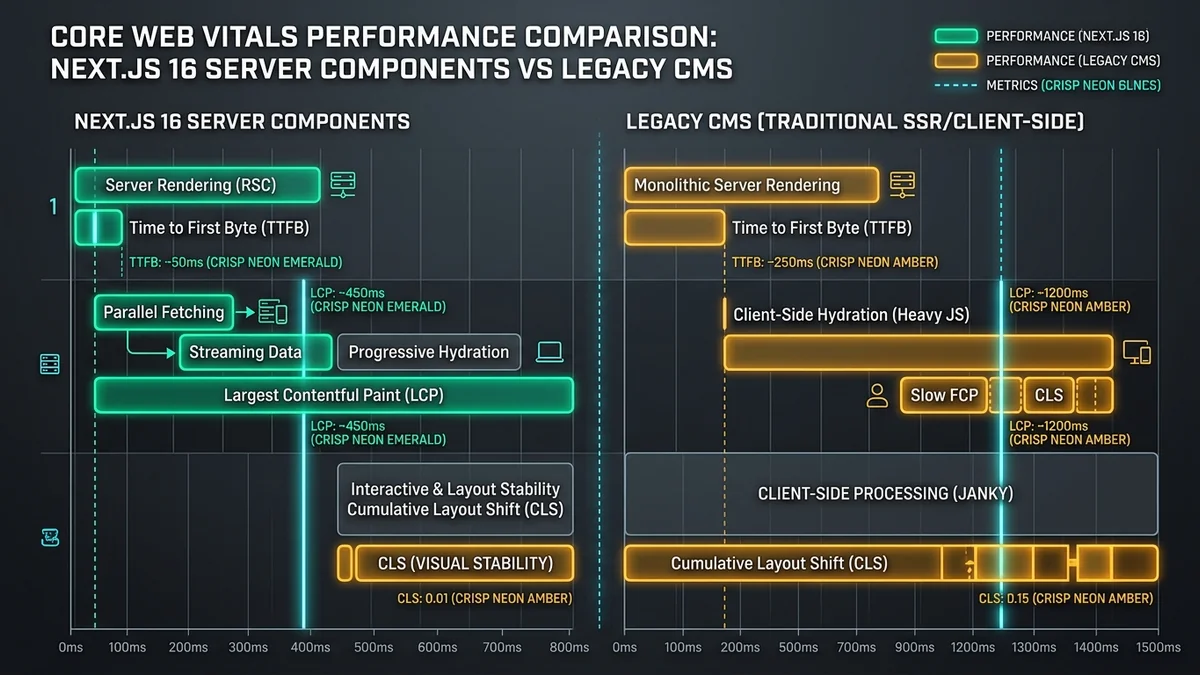
Core Web Vitals performance comparison Next.js 16 Server Components vs legacy CMS — Binary Froster
Figure 2: Core Web Vitals latency waterfall: comparing Next.js 16 Server Components streaming against legacy CMS server render lag.

2. The 3-Year Total Cost of Ownership (TCO) Reality

Businesses often choose WordPress or Webflow believing they are "cheaper." But over three years:

  • WordPress: Requires ongoing plugin subscription renewals ($500–$2,000/yr), managed PHP hosting ($30–$250/mo), security patch firefighting, and expensive emergency developer hours when plugin updates break the site.
  • Webflow: Imposes aggressive tier-based pricing increases based on traffic and form submissions, quickly reaching $100–$400+/mo for growing businesses, with severe CMS collection item limits (maximum 10,000 items).
  • Next.js: Costs $0 in recurring platform subscription fees. Static pages deploy to edge CDNs for cents per month, with zero plugin subscription overhead and 100% intellectual property ownership.

Hosting and infrastructure scalability comparison graph for 1 million monthly requests — Binary Froster
Figure 3: Hosting and infrastructure scalability comparison: Next.js Edge hosting ($25/mo) vs dedicated WordPress VPS ($120/mo) across 1 million monthly requests.

Upgrade to a High-Performance Next.js Platform

Binary Froster builds custom Next.js web applications and headless platforms that achieve 100 PageSpeed scores, sub-second load times, and complete IP code ownership.

Direct Answers & Architectural FAQ

Frequently Asked Technical Questions

Q1.Why is Next.js better than WordPress for Google SEO ranking?

Next.js delivers near-instant server-rendered or static HTML with optimized Core Web Vitals (sub-second LCP, zero CLS), which Google's search algorithms reward directly over slow, bloated PHP CMS websites.

Q2.Can non-technical team members edit content on a Next.js website?

Yes. By pairing Next.js with a headless CMS (Sanity, Strapi, Contentful), content marketing teams enjoy an intuitive visual editing dashboard while developers maintain complete control over performance and code architecture.

Q3.Is Webflow suitable for complex web applications or custom logic?

No. Webflow excels at static visual design portfolios, but struggles with user authentication, relational databases, backend server actions, and deep AI integrations.

Q4.How difficult is it to migrate an existing WordPress site to Next.js?

Straightforward. Existing blog posts, URLs, and image assets can be programmatically exported into static JSON/Markdown or connected via the WordPress REST API to maintain all existing search rankings.

Q5.How does hosting cost compare between Next.js Edge and WordPress hosting?

Next.js Edge hosting on platforms like Vercel or Cloudflare costs approximately $20–$40/month for millions of page views due to serverless caching, whereas high-traffic WordPress sites often require $120–$300/month in dedicated managed servers.

Shivam Dube — Founder & Lead AI Engineer at Binary Froster

Shivam Dube

Founder & Lead AI Engineer

Founder and Principal AI Engineer at Binary Froster, specializing in enterprise LLM pipelines, autonomous agent architectures, and machine learning solutions.

Recommended Reading

Related Architecture Guides