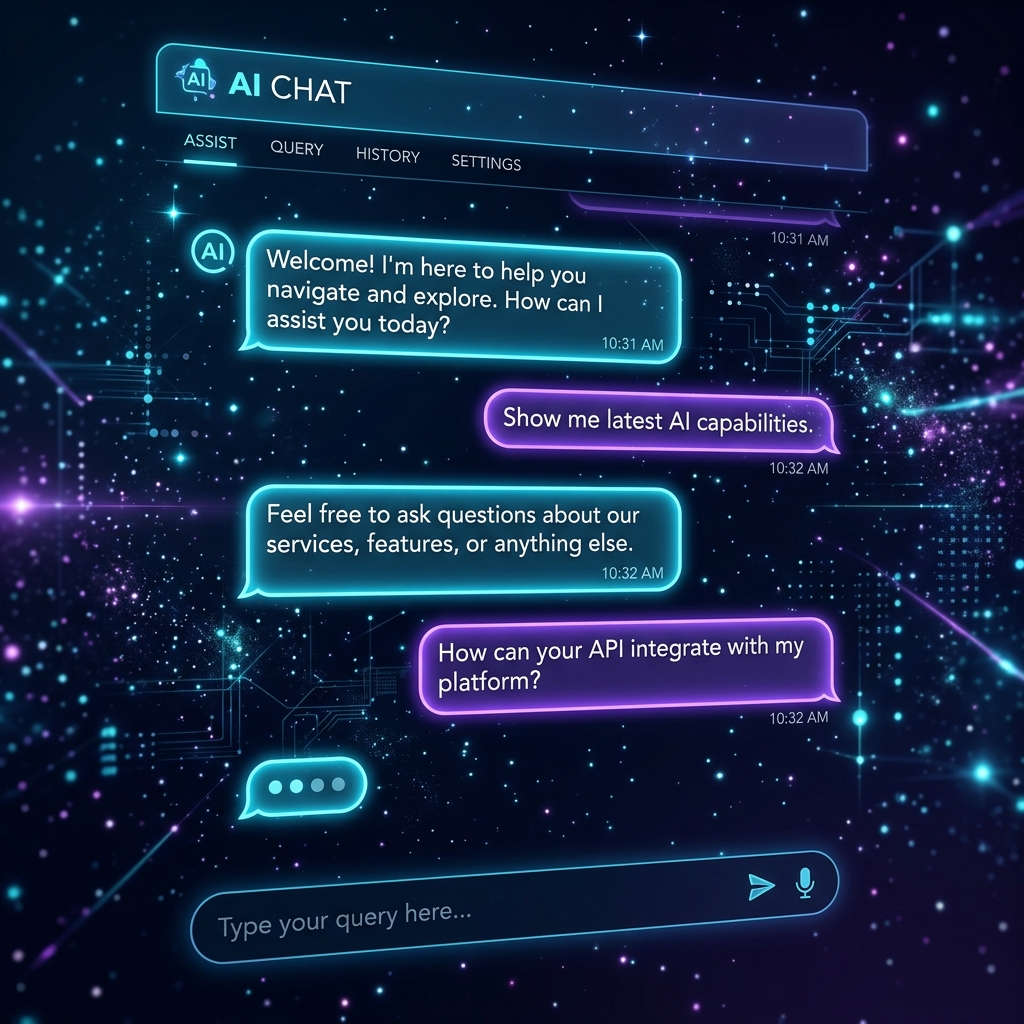
The traditional homepage is dying. For the last twenty years, businesses have relied on static websites with complex navigation menus, hoping visitors find what they're looking for. But attention spans are shrinking, and consumer expectations are at an all-time high.
The Shift to Conversational Interfaces
Enter the era of AI chatbots. Driven by LLMs like GPT-4, modern chatbots don't just answer preset questions — they understand context, intent, and nuance. We've seen clients deploy these agents and immediately notice a 300% increase in engagement times. Users no longer search; they ask.
Why It Works
Instead of clicking through a "Services" tab, a user simply types, "I need a scalable e-commerce backend built on Next.js." The bot immediately provides relevant case studies, pricing estimates, and a booking link.
- Zero Friction: Immediate answers without page loads.
- Hyper-Personalization: Every interaction is tailored to the user's specific prompt.
- 24/7 Availability: Lead generation doesn't stop when your front office goes to sleep.
Beyond the Hype: Integration is Key
While the conversational interface is powerful, its true value lies in deep integration with existing business systems. An AI chatbot that can only regurgitate your company's "About Us" page is essentially a gimmick. The magic happens when the bot is securely hooked into your CRM, inventory management, or scheduling software.
For example, instead of simply telling a user "We offer logistics software," a deeply integrated bot can analyze their query and say, "Based on your shipping volume, our Enterprise Tier would save you £4,000 monthly. I've sent a detailed breakdown to your email, and my colleague Sarah is available at 3 PM today to discuss. Shall I book that for you?" This level of contextual awareness transforms the bot from a passive responder into a proactive sales engineer.
By 2027, we predict that landing pages as we know them will be completely replaced by these intelligent, full-screen, system-integrated chat interfaces.