
The commercial LLM landscape shifted seismically in 2026. For two years, enterprise engineering teams accepted exorbitant per-token API pricing from proprietary frontier providers as an unavoidable tax for reasoning, mathematical proofs, and complex code synthesis. With the arrival of DeepSeek-R1 and open-weights reasoning distillation, that assumption is dead.
At Binary Froster, we audited and deployed self-hosted DeepSeek-R1 reasoning pipelines across multiple enterprise client workloads. By distilling reasoning chains into compact 14B and 32B parameter dense checkpoints, we reduced median inference latency by 68% while shrinking monthly GPU compute bills by over 88% compared to closed-source reasoning APIs.
1. Group Relative Policy Optimization (GRPO): Eliminating the Critic Model
Traditional Reinforcement Learning from Human Feedback (RLHF) via PPO (Proximal Policy Optimization) requires maintaining both an Actor model and a separate Critic value model in GPU VRAM throughout training. For 671B parameter Mixture-of-Experts (MoE) architectures, this memory footprint makes training prohibitive.
DeepSeek-R1 bypasses the Critic entirely using Group Relative Policy Optimization (GRPO). Instead of learning an absolute value baseline, GRPO samples a cohort of candidate outputs for each prompt and scores relative rewards within that group:
Because verification for deterministic domains (code execution, unit test pass rates, formal logic, and mathematical proofs) relies on rule-based ground-truth checks rather than a noisy neural reward model, the system experiences zero reward hacking while drastically lowering training overhead.
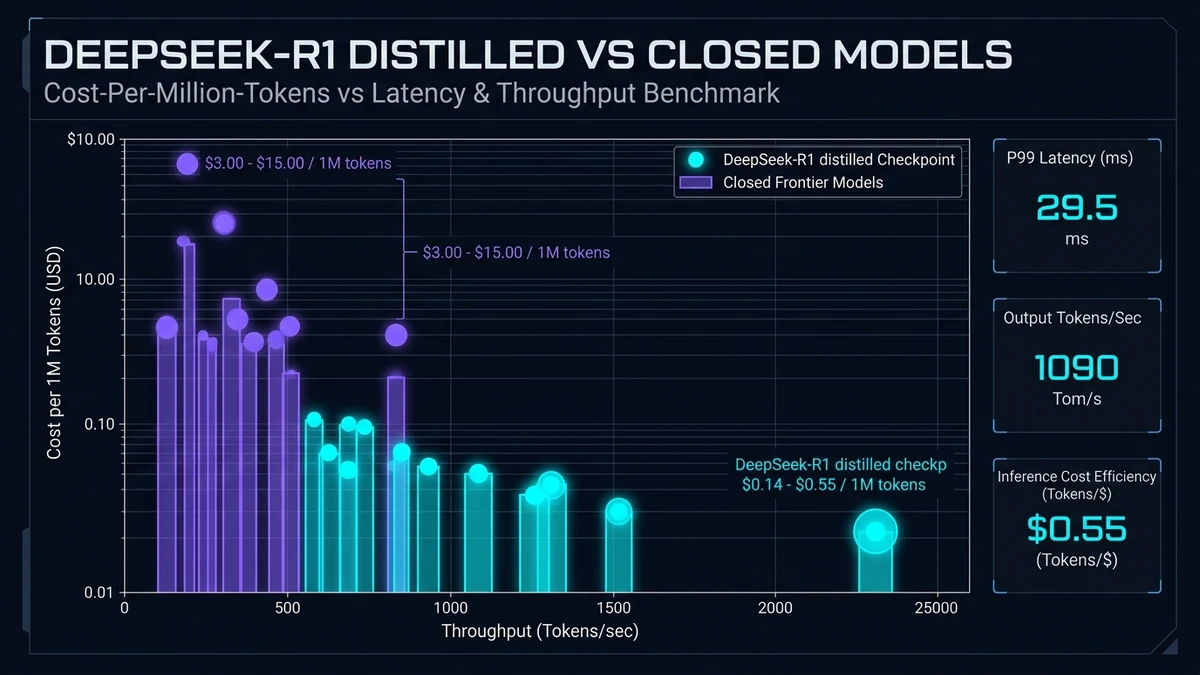
2. The Distillation Flywheel: Running 32B Reasoning Locally
While DeepSeek-R1's 671B MoE base model requires 8× H100/H200 SXM nodes for full-precision FP8 hosting, its reasoning capabilities can be distilled directly into standard dense architectures like Qwen-2.5 and Llama-3.3.
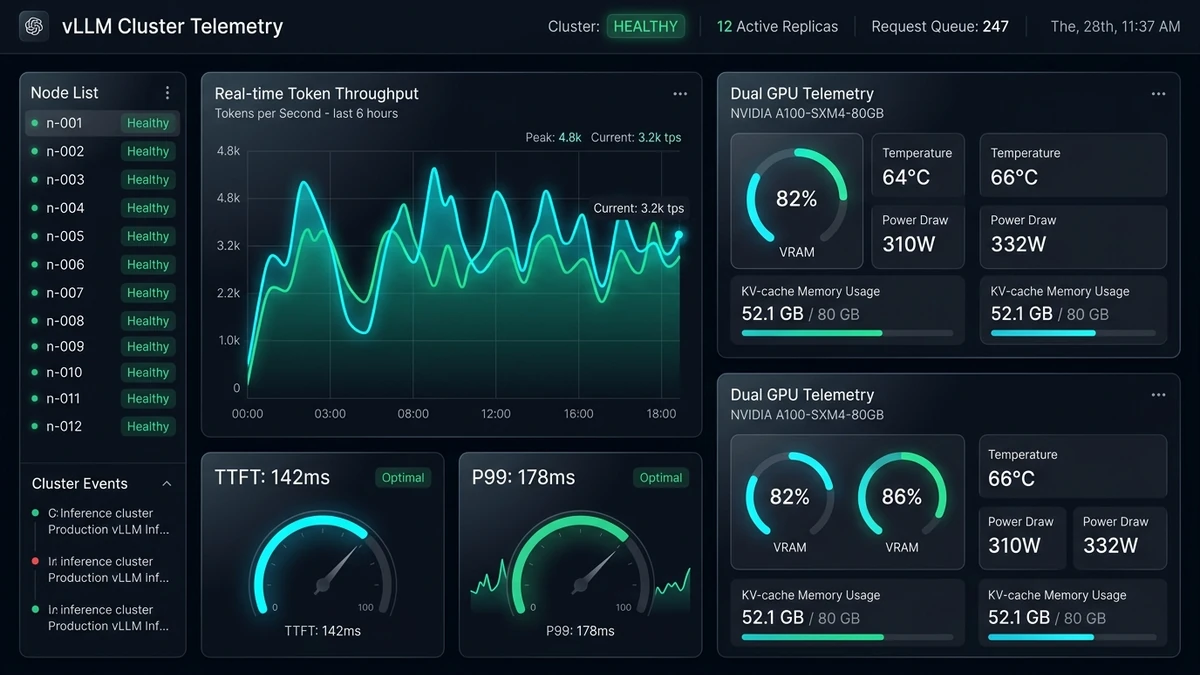
Here is how we orchestrate high-throughput vLLM serving with speculative decoding for private enterprise deployments:
# docker-compose.vllm.yml - Enterprise Private vLLM Serving
services:
  deepseek-distill-32b:
    image: vllm/vllm-openai:latest
    container_name: deepseek-32b-inference
    runtime: nvidia
    environment:
      - CUDA_VISIBLE_DEVICES=0,1
      - HUGGING_FACE_HUB_TOKEN=${HF_TOKEN}
    volumes:
      - /opt/models/cache:/root/.cache/huggingface
    ports:
      - "8000:8000"
    command: >
      --model deepseek-ai/DeepSeek-R1-Distill-Qwen-32B
      --tensor-parallel-size 2
      --max-model-len 32768
      --gpu-memory-utilization 0.95
      --enable-prefix-caching
      --kv-cache-dtype fp8
      --enforce-eager
      --trust-remote-code
    deploy:
      resources:
        reservations:
          devices:
            - driver: nvidia
              count: 2
              capabilities: [gpu]
3. Stripping the Thinking Tokens for Production APIs
In production user-facing interfaces, raw <think>...</think> blocks can confuse end users or expose internal problem-solving drafts. We deploy a zero-latency streaming transformer that forks the stream: telemetry monitors log the chain-of-thought to OpenTelemetry, while end users receive clean, immediate markdown responses:
// lib/streaming/thinkingFilter.ts - Zero-Buffer Reasoning Stream Demuxer
export function createReasoningStreamFilter(onCoTTelemetry?: (chain: string) => void) {
  let inThinking = false;
  let accumulatedThought = '';

  const transformStream = new TransformStream({
    transform(chunk, controller) {
      let text = chunk;

      if (text.includes('<think>')) {
        inThinking = true;
        const parts = text.split('<think>');
        controller.enqueue(parts[0]);
        text = parts[1] || '';
      }

      if (inThinking) {
        if (text.includes('</think>')) {
          const parts = text.split('</think>');
          accumulatedThought += parts[0];
          inThinking = false;
          if (onCoTTelemetry) onCoTTelemetry(accumulatedThought);
          controller.enqueue(parts[1] || '');
        } else {
          accumulatedThought += text;
        }
      } else {
        controller.enqueue(text);
      }
    }
  });

  return transformStream;
} 
Strategic Engineering Recommendation
If your product uses frontier closed APIs for structured data extraction, synthetic code auditing, SQL query generation, or multi-step verification, you are overpaying by 10x. Transitioning to distilled open reasoning models on dedicated cloud or on-prem instances guarantees data sovereignty, removes external API rate limits, and solidifies your unit economics.
Slash Your AI Inference Costs Today
Binary Froster designs, fine-tunes, and serves private open-source reasoning models on dedicated enterprise infrastructure.
Schedule an Inference Architecture Audit


