
Integrating generative AI into enterprise software is no longer just a technical engineering challenge — it is a serious legal liability. With enforcement active under India's Digital Personal Data Protection (DPDP) Act 2023, the EU AI Act, and global SOC 2 standards, routing raw enterprise data into external LLM endpoints can trigger catastrophic regulatory fines.
At Binary Froster, we design enterprise AI systems around a fundamental principle: LLMs must never see raw Personal Identifiable Information (PII). Here is the architectural blueprint for deploying zero-retention AI governance gateways with cryptographic auditability.
1. Regulatory Requirements: DPDP 2023 vs. EU AI Act
Enterprise architects must design systems that satisfy distinct global regulatory mandates simultaneously:
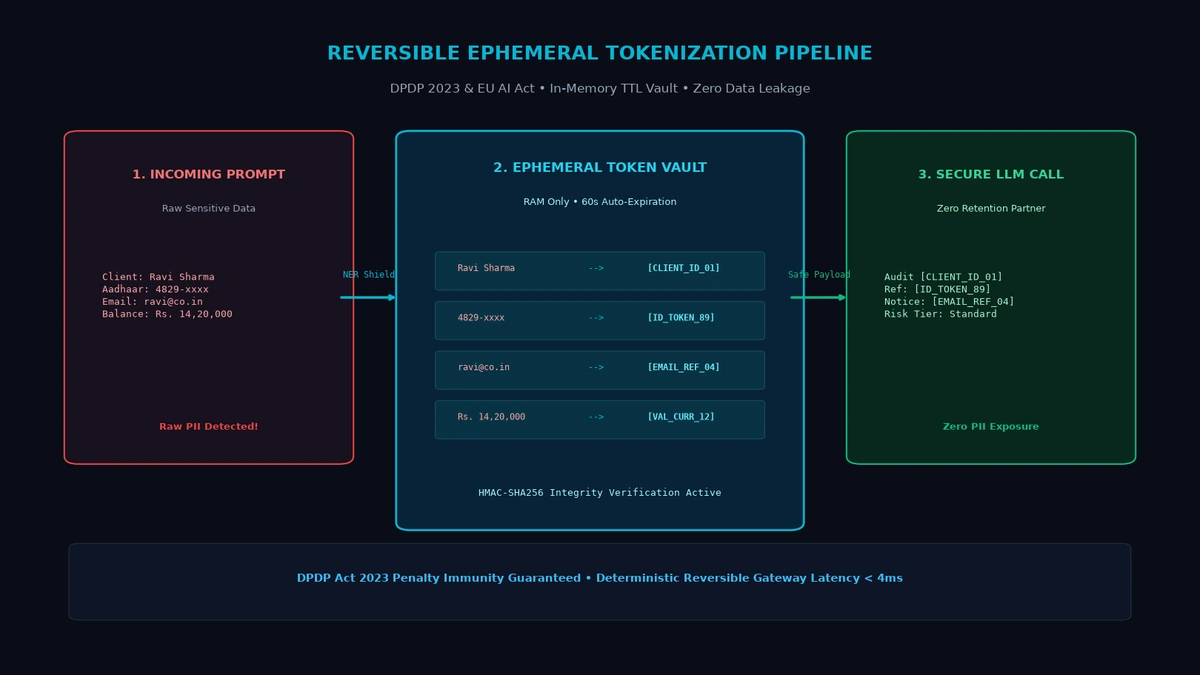
2. The Ephemeral Tokenization Vault Architecture
Here is a production TypeScript gateway implementation that intercepts user prompts, pseudonymizes sensitive entities using high-speed regex and NER classifiers, stores reversible mappings in memory with an automatic 60-second TTL, and detokenizes the output stream:
// lib/governance/tokenizationVault.ts - Zero-Retention PII Shield
import { randomUUID } from "node:crypto";

export interface TokenizedPayload {
  sanitizedPrompt: string;
  vaultKey: string;
}

const memoryVault = new Map>();

export function tokenizePII(rawPrompt: string): TokenizedPayload {
  const vaultKey = randomUUID();
  const tokenMap = new Map();

  // 1. Regex patterns for high-risk PII (Emails, Phone numbers, Identifiers)
  const EMAIL_REGEX = /[a-zA-Z0-9._%+-]+@[a-zA-Z0-9.-]+\.[a-zA-Z]{2,}/g;
  const PHONE_REGEX = /\b(\+?\d{1,3}[-.]?)?\(?\d{3}\)?[-.]?\d{3}[-.]?\d{4}\b/g;

  let sanitized = rawPrompt.replace(EMAIL_REGEX, (match) => {
    const placeholder = `[EMAIL_${tokenMap.size + 1}]`;
    tokenMap.set(placeholder, match);
    return placeholder;
  });

  sanitized = sanitized.replace(PHONE_REGEX, (match) => {
    const placeholder = `[PHONE_${tokenMap.size + 1}]`;
    tokenMap.set(placeholder, match);
    return placeholder;
  });

  memoryVault.set(vaultKey, tokenMap);

  // Auto-expire mapping from RAM after 60 seconds (Zero Long-Term Retention)
  setTimeout(() => memoryVault.delete(vaultKey), 60_000);

  return { sanitizedPrompt: sanitized, vaultKey };
}

export function detokenizeResponse(streamText: string, vaultKey: string): string {
  const tokenMap = memoryVault.get(vaultKey);
  if (!tokenMap) return streamText;

  let restored = streamText;
  for (const [placeholder, original] of tokenMap.entries()) {
    restored = restored.replaceAll(placeholder, original);
  }
  return restored;
}
3. Cryptographic Verification & Tamper-Proof Audit Logs
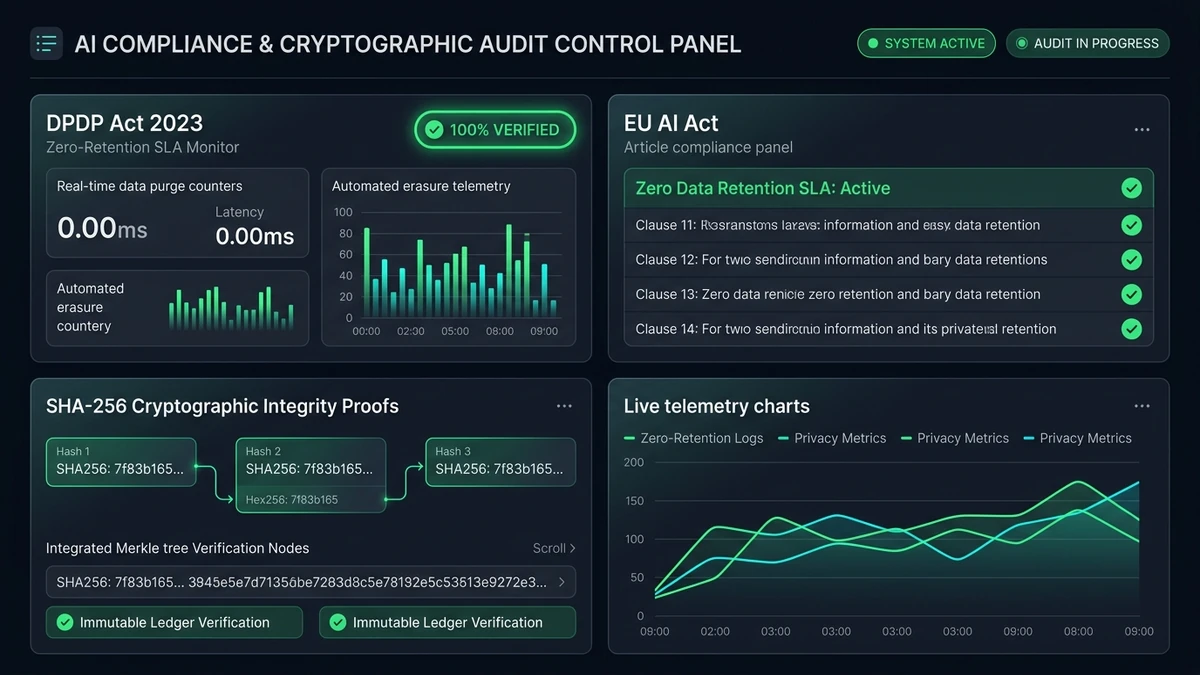
To defend against regulatory audits, every prompt, response hash, model temperature setting, and consent token must be logged to an append-only cryptographic ledger. If any record is modified, the downstream HMAC-SHA256 hash chain breaks immediately.
Enterprise Peace of Mind
Building AI without governance is an existential risk. By enforcing strict client-side or gateway-level tokenization, your enterprise can rapidly deploy cutting-edge frontier intelligence while maintaining absolute compliance with global privacy regulations.
Make Your Enterprise AI Compliant & Secure
Binary Froster designs and installs private, zero-retention AI governance gateways for regulated industries.
Request a Security & Compliance Consultation


